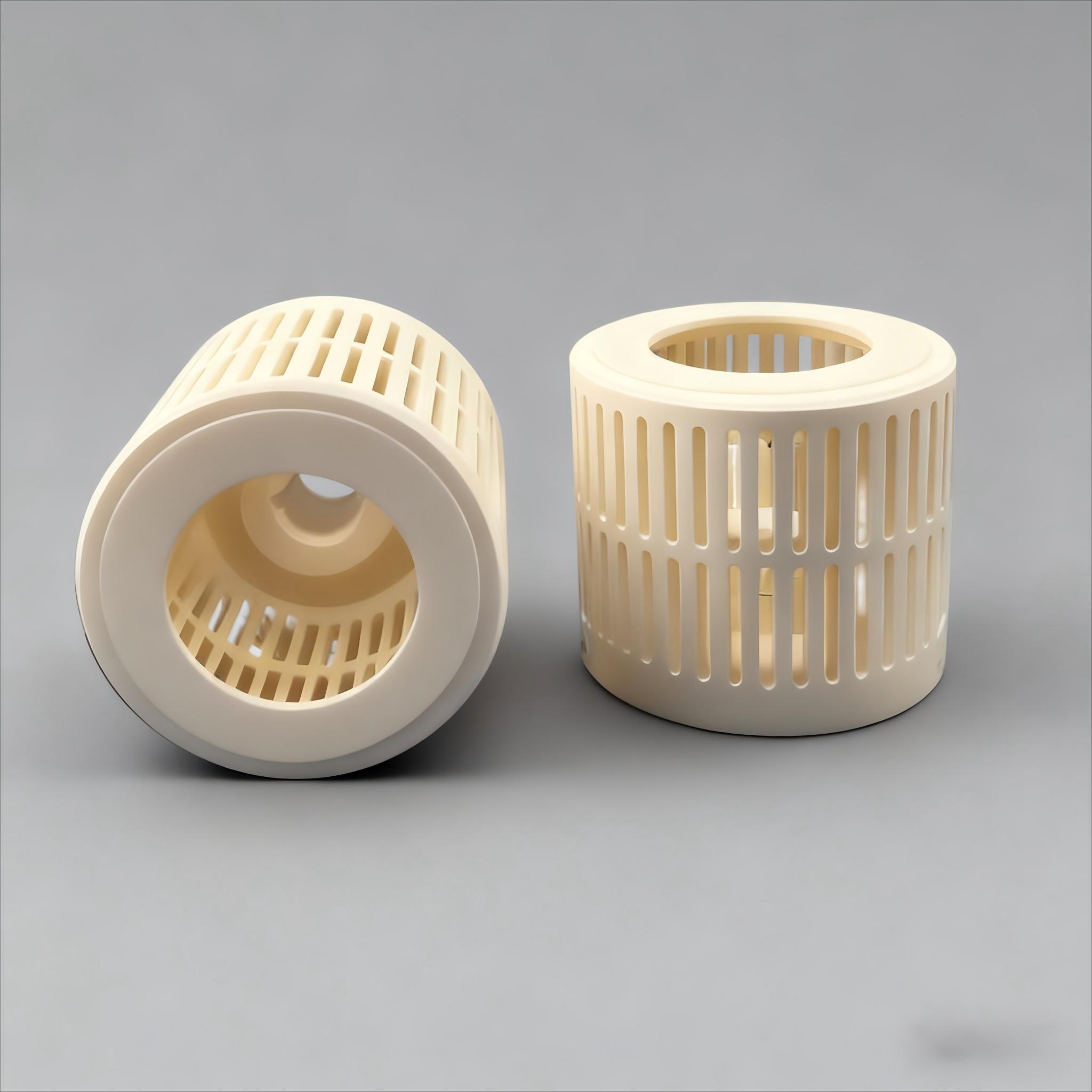
The classifying wheel is a core component of air classifiers and classifiers, specifically designed for separating powder particles by size. Coarse and fine materials moving with the rising airflow to the classification zone are separated. Fine particles meeting the size requirements pass through the classifying wheel and are collected in the next component, while coarse particles descend to the grinding zone for further crushing.
Classifying wheels are classified according to their materials: ceramic classifying wheels, metal classifying wheels, and combined classifying wheels. Here, we will focus on ceramic classifying wheels, with alumina ceramic classifying wheels being a common type. Alumina ceramic is a highly wear-resistant precision ceramic material with extremely high hardness and wear resistance, strong corrosion resistance, high temperature resistance, corrosion resistance, and bioinertness, making it an excellent choice for manufacturing classifying wheels.
The ceramic classifying wheel consists of a front flange, a rear flange, multiple blades, and a sealing plate. The blades are fixedly connected to the front and rear flanges. The sealing plate has an annular groove, and the rear ends of the blades are inserted into this groove. There are feed slots between adjacent blades, and the inner sides of multiple blades form cavities. The rear end of the blade has a radially enlarged blade tail. The rotational linear velocity of the blade tail is higher than that of the blade portion in front of it. Therefore, the airflow generated by the rotation of the blade tail can block the powder outside the blade tail, so that the material powder must be selected by the rotation of the blade and enter the discharge pipe from the feed slot.